
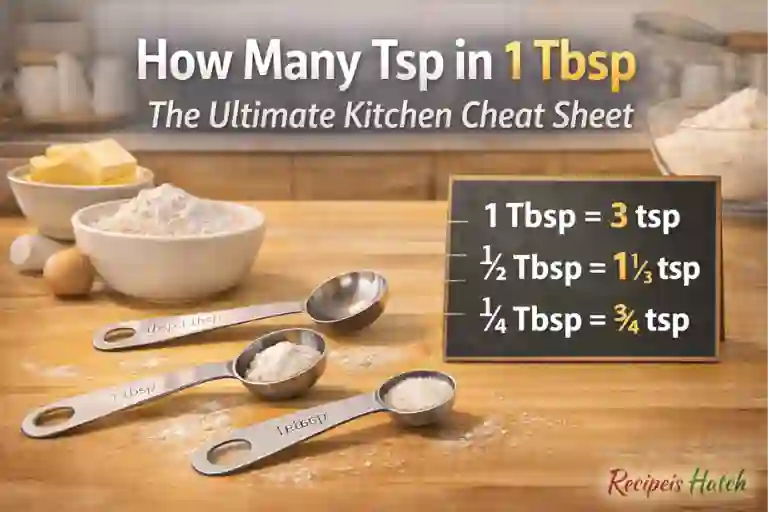
If you’ve ever wondered How Many Tsp in 1 Tbsp, the answer is simple: 1 tablespoon equals 3 teaspoons. This is one of the most common tsp to tbsp conversions used in cooking and baking. Knowing this basic kitchen measurement conversion can save you time and prevent mistakes when following a recipe.
For quick reference:
- ½ tablespoon = 1½ teaspoons
- ¼ tablespoon = ¾ teaspoon
- 2 tablespoons = 6 teaspoons
Even a small miscalculation can affect the taste or texture of your dish, especially in baking. Whether you’re measuring flour, sugar, or butter, this quick answer helps you convert teaspoons to tablespoons accurately every time. Keep reading for full conversion charts, tips, and tricks to make your cooking easier and precise.
Quick Answer: 1 Tablespoon = 3 Teaspoons
The answer is simple and easy to remember:
1 tablespoon (Tbsp) = 3 teaspoons (tsp)
This is the standard kitchen measurement used in almost every recipe. Knowing this helps you convert teaspoons to tablespoons quickly and ensures your baking and cooking turn out perfectly.
Quick Reference Table:
| Tablespoon (Tbsp) | Teaspoons (tsp) |
| ¼ Tbsp | ¾ tsp |
| ½ Tbsp | 1½ tsp |
| 1 Tbsp | 3 tsp |
| 2 Tbsp | 6 tsp |
Complete Tsp to Tbsp Conversion Chart
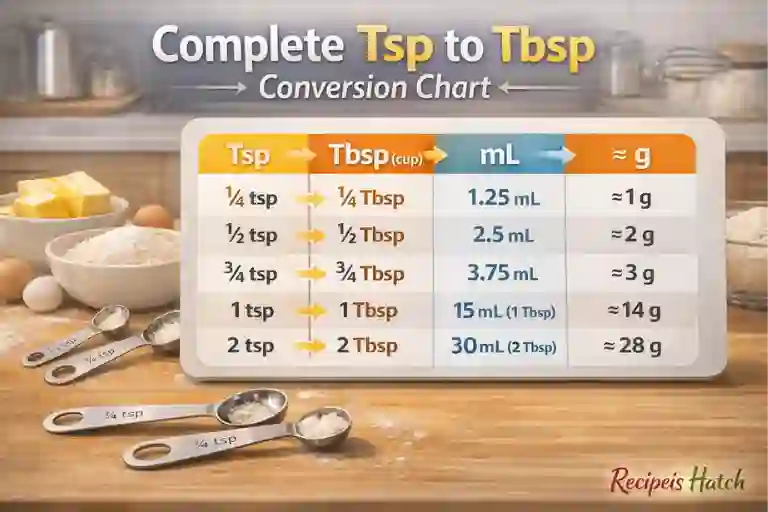
For quick and accurate kitchen measurements, here’s a complete tsp to tbsp conversion chart that includes fractions, metric equivalents, and weights for common baking ingredients. This makes it easier to convert teaspoons to tablespoons whether you’re cooking or baking.
You might also like: How To Convert 120 C to F
| Tablespoon (Tbsp) | Teaspoons (tsp) | Metric (mL) | Approx. Weight (grams) |
| ¼ Tbsp | ¾ tsp | 3.75 mL | 4 g flour / 5 g sugar / 3.5 g butter |
| ½ Tbsp | 1½ tsp | 7.5 mL | 8 g flour / 10 g sugar / 7 g butter |
| ¾ Tbsp | 2¼ tsp | 11.25 mL | 12 g flour / 15 g sugar / 10.5 g butter |
| 1 Tbsp | 3 tsp | 15 mL | 16 g flour / 20 g sugar / 14 g butter |
| 2 Tbsp | 6 tsp | 30 mL | 32 g flour / 40 g sugar / 28 g butter |
| 16 Tbsp | 48 tsp | 240 mL | 256 g flour / 320 g sugar / 224 g butter |
Pro Tips for Using This Chart:
- Always use level measurements for accuracy, especially in baking.
- For liquids, measure in mL for consistent results.
- For dry ingredients, check the weight conversions to avoid dense or too-light dough.
Imperial vs Metric Measurements – What You Need to Know
When it comes to teaspoons and tablespoons, not all measurements are exactly the same around the world. In the US, 1 tablespoon equals 3 teaspoons, which is approximately 15 mL. However, in the UK, a tablespoon is slightly larger, about 17.7 mL, while a teaspoon remains roughly the same at 5 mL.
This difference can affect your baking and cooking, especially if you’re following an international recipe. For example, using a UK tablespoon in a US recipe could slightly alter the sweetness or texture of your dish.
Tips for Metric-Only Recipes:
- Always measure liquids in milliliters (mL) for accuracy.
- Use a digital kitchen scale for dry ingredients like flour, sugar, or butter.
- Convert tablespoons to mL using 1 Tbsp ≈ 15 mL for consistency.
Ingredient-Specific Conversions
Not all ingredients are created equal when it comes to teaspoons and tablespoons. Ingredient density matters because 1 tablespoon of flour does not weigh the same as 1 tablespoon of sugar or butter. Understanding this is key for accurate measurements, especially in baking where precision makes a big difference.
Here’s a quick ingredient-specific conversion guide:
| Ingredient | 1 tsp (grams) | 1 Tbsp (grams) |
| Flour | 2 g | 8 g |
| Sugar | 4 g | 12 g |
| Butter | 3.5 g | 14 g |
| Cocoa Powder | 2.5 g | 7.5 g |
| Honey / Syrup | 7 g | 21 g |
Why density matters:
- Flour is light and airy; scooping can trap air, giving more volume but less weight.
- Sugar is denser; the same tablespoon gives more weight than flour.
- Butter and liquids have their own density, so measuring in grams or mL ensures recipe accuracy.
Tips for Measuring Without a Teaspoon or Tablespoon
What if you don’t have a teaspoon or tablespoon on hand? Don’t worry—there are simple ways to measure ingredients accurately using items you already have in your kitchen.
Here are some easy methods:
- Use a cup:
- 1 cup = 16 tablespoons, so you can divide it for smaller measurements.
- Use a knife or spoon edge:
- Level off ingredients like flour or sugar with the back of a knife to approximate a teaspoon or tablespoon.
- Use a kitchen scale:
- Measure ingredients in grams for precision. Example: 1 Tbsp flour ≈ 8 g.
- Measure ingredients in grams for precision. Example: 1 Tbsp flour ≈ 8 g.
- Improvised tools:
- Tablespoons from cutlery sets, shot glasses, or small measuring cups work in a pinch.
Common Mistakes & How to Avoid Them
Even experienced cooks can make simple mistakes when measuring teaspoons and tablespoons, and these small errors can affect your recipe’s outcome. Here are the most common mistakes and how to fix them:
1. Overfilling spoons
- Scooping ingredients without leveling can add extra tsp or tbsp, altering flavor or texture.
- Fix: Always use a knife or straight edge to level off dry ingredients like flour or sugar.
2. Heaping measures
- Heaping spoons give inconsistent results, especially in baking.
- Fix: Measure level spoons for accuracy in tsp to tbsp conversions.
3. Confusing metric vs imperial measurements
- A US tablespoon (15 mL) differs slightly from a UK tablespoon (17.7 mL).
- Fix: Use milliliters for liquids and a kitchen scale for dry ingredients to ensure precision.
Less Common Measurement Conversions
Not all kitchen measurements are as straightforward as 1 Tbsp = 3 tsp. Some less common conversions can be confusing, especially when recipes use dessert spoons, fractions of teaspoons, or require conversions to cups, ounces, or milliliters.
1. Dessert Spoon vs Tablespoon
- A dessert spoon is slightly smaller than a tablespoon, typically 2 tsp.
- Useful in recipes for sauces or desserts that call for precise small amounts.
2. Fractional Teaspoons
- ½ tsp = 1.5 mL ≈ 2 g flour / 4 g sugar
- ¼ tsp = 1.25 mL ≈ 1 g flour / 2 g sugar
- ⅓ tsp ≈ 1.7 mL
- Using fractions helps with tsp to tbsp conversions when adjusting recipes.
3. Converting Tablespoons to Ounces, Cups, and mL
- 1 Tbsp ≈ 0.5 fl oz ≈ 15 mL
- 2 Tbsp ≈ 1 fl oz ≈ 30 mL
- 16 Tbsp = 1 cup ≈ 240 mL
- These conversions are essential for international recipes and metric-only cooking.
Memory Tricks & Practical Hacks
Cooking and baking become much easier when you remember a few simple rules for teaspoons and tablespoons. These memory tricks help you convert quickly without constantly checking a chart:
1. Easy Rules to Remember
- 1 Tbsp = 3 tsp
- 16 Tbsp = 1 cup
- ½ Tbsp = 1½ tsp
- ¼ Tbsp = ¾ tsp
2. Quick Calculations for Recipes
- Doubling or halving a recipe? Simply multiply or divide the tsp and tbsp amounts.
- Need 2½ Tbsp of sugar? Convert to 7½ tsp for precision.
- For liquids, remember 1 Tbsp ≈ 15 mL, which makes metric conversions fast and easy.
Advanced Conversion Tips
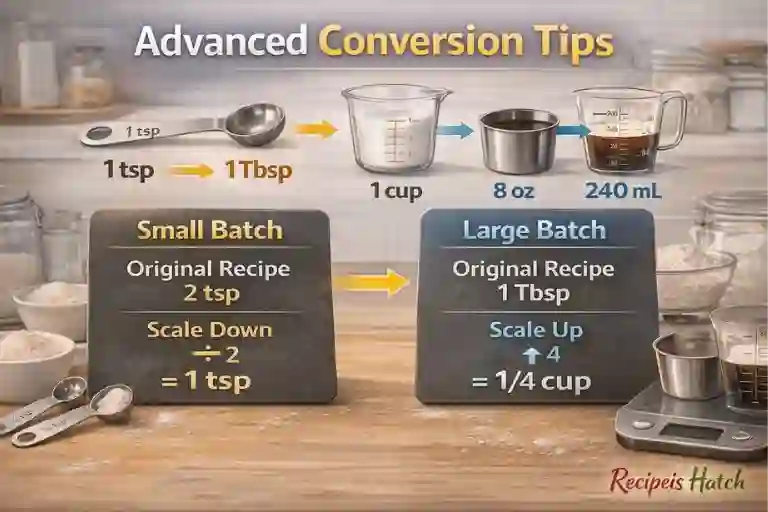
Sometimes, you need to go beyond simple tsp to tbsp conversions—especially when scaling recipes or working with multiple measurement units. Here’s how to handle multi-step conversions and large or small batch adjustments:
1. Multi-Step Conversions
- Tsp → Tbsp → Cups → Ounces
- 3 tsp = 1 Tbsp
- 16 Tbsp = 1 Cup
- 1 Cup ≈ 8 fl oz ≈ 240 mL
- Using this chain, you can easily convert any recipe from small to large quantities.
2. Scaling Recipes Quickly
- Doubling a recipe? Multiply all tsp and tbsp amounts by 2.
- Halving a recipe? Divide all measurements by 2.
- For larger batches, convert tablespoons to cups or ounces to make measuring faster and more practical.
Printable Kitchen Conversion Cheat Sheet
To make your cooking and baking even easier, we’ve created a fully printable kitchen conversion cheat sheet. This chart includes all tsp ↔ tbsp conversions, metric equivalents (mL), and ingredient-specific weights so you can reference it quickly while cooking.
Why you need it:
- Save time by having all common and less common measurements in one place.
- Avoid mistakes with tsp to tbsp conversions and metric conversions.
- Perfect for scaling recipes, baking, or preparing sauces.
How to use it:
- Download the PDF chart.
- Print it and keep it near your kitchen counter.
- Use it anytime you need a fast conversion reference, whether you’re measuring flour, sugar, butter, or liquids.
FAQs About How Many Tsp In 1 Tbsp?
Here are the most common questions about teaspoons, tablespoons, and conversions, answered clearly to make your cooking and baking easier:
1. How many tsp in ½ Tbsp?
½ tablespoon = 1½ teaspoons. This is a quick rule to remember for accurate tsp to tbsp conversions.
2. Can I substitute tsp for Tbsp in recipes?
Yes, but remember 1 Tbsp = 3 tsp. If a recipe calls for 1 Tbsp and you only have a tsp, use 3 tsp instead.
3. What is a dessert spoon and how many tsp does it equal?
A dessert spoon is smaller than a tablespoon, typically equal to 2 tsp, and is often used for sauces and desserts.
How many tablespoons in a cup?
1 cup = 16 tablespoons, which is helpful when scaling recipes or using smaller measuring spoons.
5. How to adjust recipe measurements if I don’t have proper spoons?
Use cups, knives, kitchen scales, or improvised tools. Always level ingredients for accuracy, especially in baking or precise cooking.
Final Thoughts
Understanding how many teaspoons are in a tablespoon is one of the simplest yet most important skills in the kitchen. With this guide, you now have everything you need: quick answers, complete conversion charts, metric equivalents, ingredient-specific weights, and practical tips.
Whether you’re baking, cooking, or adjusting recipes, knowing tsp to tbsp conversions ensures your dishes turn out perfectly every time. Remember to use level measurements, follow the cheat sheet, and apply our memory tricks for faster, more accurate results.
Keep this guide handy, and you’ll never have to worry about mismeasuring ingredients again. From small tweaks to large batch conversions, accurate measurements will make your cooking stress-free and delicious.