
Making homemade pasta dough sounds simple, but many people struggle to get it right. The dough turns out too dry, too sticky, or just doesn’t feel right. That’s because most recipes only show the steps—but don’t explain the technique, texture, or small details that truly matter.
In this guide, you’ll learn how to make pasta dough step by step using simple ingredients and clear instructions. We’ll cover the perfect pasta dough ratio, how to knead it properly, and how to tell if your dough has the right consistency. Whether you’re making pasta dough by hand or without a machine, this guide will help you succeed.
By the end, you’ll not only follow a pasta dough recipe, but also understand exactly how to fix common problems and create smooth, fresh pasta at home with confidence.
Quick Answer: How to Make Homemade Pasta Dough
Homemade pasta dough is made with simple ingredients like flour and eggs, mixed into a smooth, elastic dough. The basic pasta dough ratio is about 1 cup flour per 1 egg. To make it, combine ingredients, knead until smooth, rest the dough, then roll and shape into fresh pasta.
WHAT IS HOMEMADE PASTA DOUGH?
Homemade pasta dough is a simple mixture of flour and eggs that is kneaded into a smooth, elastic dough and then rolled into fresh pasta. Unlike dried pasta, this dough is made fresh at home, which gives it a softer texture and richer flavor.
A basic pasta dough recipe uses just a few ingredients, but the real difference comes from the technique—how you mix, knead, and rest the dough. When done right, the dough becomes easy to roll and shape into different pasta styles like spaghetti, fettuccine, or ravioli.
Fresh vs Store-Bought Pasta
- Fresh pasta dough is soft, delicate, and cooks quickly
- Store-bought pasta is dried, firmer, and has a longer shelf life
In short, homemade pasta dough is all about freshness, control, and better texture.
HOMEMADE VS STORE-BOUGHT PASTA
Understanding the difference helps you decide when to use each.
Taste
- Homemade pasta dough has a richer, more natural flavor
- Store-bought pasta tastes more neutral
Texture
- Fresh pasta is soft, silky, and tender
- Dried pasta is firmer and slightly chewy
Cost
- Homemade pasta is budget-friendly (basic ingredients)
- Store-bought pasta is convenient but adds up over time
When to Choose Each
- Choose homemade pasta dough when you want better flavor and a special meal
- Choose store-bought when you need something quick and convenient
INGREDIENTS BREAKDOWN (WITH ROLES + SUBSTITUTES)
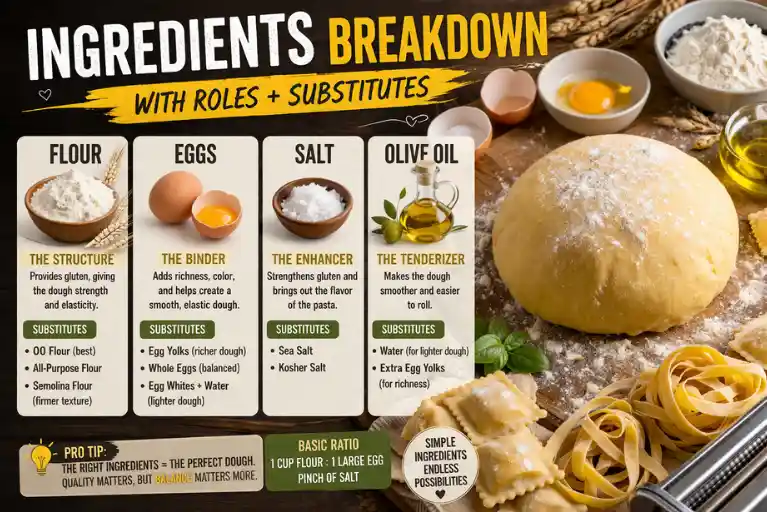
Making homemade pasta dough starts with simple ingredients, but each one plays an important role.
You might also like: Best Sun Dried Tomato Tofu Pasta
Flour (AP vs Semolina vs 00)
- All-purpose flour → Easy to find, great for beginners, soft texture
- Semolina flour → Adds firmness and bite, ideal for shapes like spaghetti
- 00 flour → Very fine, creates silky and smooth pasta dough
Best flour for pasta dough: Beginners should start with all-purpose flour, then try blends for better texture.
Eggs (Structure + Richness)
- Eggs provide structure, moisture, and richness
- They help create that classic golden color and smooth texture
A traditional pasta dough recipe uses eggs as the main liquid.
Water / Olive Oil (Optional)
- Water → Used in eggless dough or to adjust dryness
- Olive oil → Adds slight softness and flexibility
Not always required, but helpful for beginners learning how to make pasta dough
Eggless Substitutes
If you want eggless pasta dough, you can use:
- Water + flour (simple version)
- Olive oil + water (for smoother dough)
Great option for dietary needs or lighter pasta.
PERFECT PASTA DOUGH RATIO
Getting the pasta dough ratio right is the key to success.
Standard Ratio (Flour : Eggs)
- 1 cup flour : 1 large egg
This is the most reliable ratio for fresh pasta dough
Scaling Formula
- 2 cups flour → 2 eggs
- 3 cups flour → 3 eggs
Easy to scale depending on servings
Adjustments for Beginners
- Dough too dry → add a few drops of water
- Dough too sticky → add a little flour
Always adjust slowly while kneading
Climate Adjustments
- Humid weather → dough becomes sticky → use more flour
- Dry weather → dough becomes dry → add water or egg yolk
This is a hidden secret most recipes don’t explain
STEP-BY-STEP HOMEMADE PASTA DOUGH (FOOLPROOF METHOD)
Follow this step-by-step pasta dough guide to get perfect results every time.
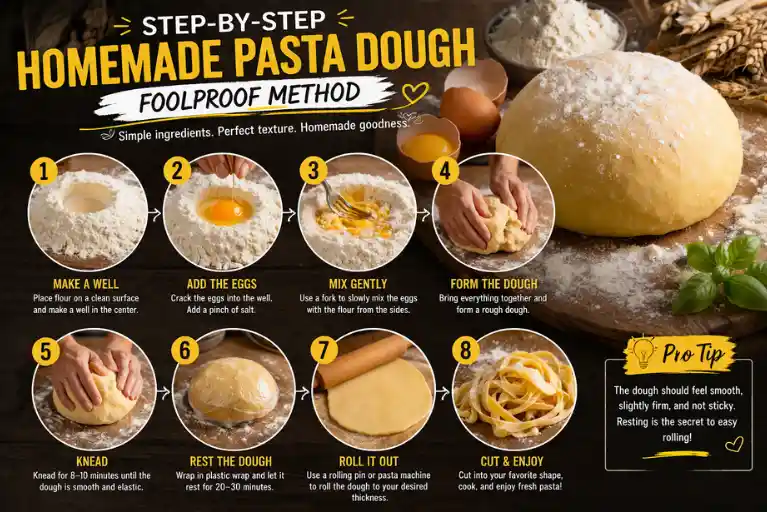
Step 1: Create a Flour Well
Place flour on a clean surface and make a well in the center. Crack eggs into the middle.
It should look like a small bowl made of flour
Step 2: Mix Ingredients
Use a fork to slowly mix eggs with flour from the edges.
Sensory cue: The mixture will turn into a thick, slightly sticky dough
Step 3: Knead the Dough
Start kneading by hand for about 8–10 minutes.
Sensory cue:
- Dough should feel smooth and slightly firm
- Not sticky, not dry
- Like soft playdough
Step 4: Rest the Dough
Wrap the dough and let it rest for 20–30 minutes.
Why? This helps gluten relax, making it easier to roll
Step 5: Roll & Shape
Roll the dough using a rolling pin or pasta machine, then cut into your desired shape.
Sensory cue:
- Dough should roll easily without tearing
- Surface should look smooth and elastic
HOW TO KNEAD PASTA DOUGH PROPERLY
Learning how to knead pasta dough properly is what turns a basic recipe into perfect pasta.
Hand Technique
- Push the dough forward using the heel of your hand
- Fold it back over itself
- Rotate slightly and repeat
Keep a steady rhythm — this builds elasticity in the dough
Kneading Time
- Knead for 8–10 minutes
- Beginners may need up to 12 minutes
Don’t rush — proper kneading is key for smooth fresh pasta dough
Signs of Proper Kneading
- Dough becomes smooth and even
- Surface looks slightly shiny
- It feels firm but not hard
- No sticky patches
If your dough still feels rough, keep kneading
HOW THE DOUGH SHOULD FEEL (TEXTURE GUIDE)
Understanding pasta dough consistency is one of the biggest secrets to success.
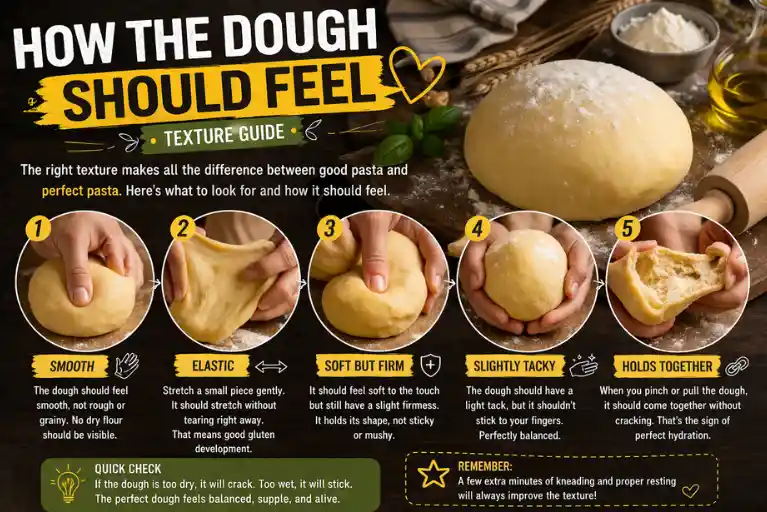
Soft vs Firm vs Sticky
- Too soft → sticks to hands, hard to shape
- Too firm → cracks and is difficult to roll
- Perfect dough → smooth, slightly firm, not sticky
Elasticity Test
Stretch the dough gently:
- If it stretches without breaking → perfect elasticity
- If it tears quickly → needs more kneading
Finger Press Test
Press your finger into the dough:
- If it slowly springs back → ready
- If it stays indented → under-kneaded
Visual + Touch Indicators
- Smooth surface (not rough)
- Slight bounce when pressed
- Feels like soft playdough
This is how you know your homemade pasta dough is ready to roll
THE SCIENCE BEHIND PERFECT PASTA DOUGH
Understanding the basics helps you fix problems easily.
Gluten Formation
When you mix flour and eggs, gluten develops.
This creates structure and allows the dough to stretch.
Elasticity vs Extensibility
- Elasticity → dough springs back
- Extensibility → dough stretches easily
Perfect pasta dough needs a balance of both
Why Kneading + Resting Matter
- Kneading builds gluten
- Resting relaxes it
Without both, your dough won’t roll smoothly
WHY RESTING THE DOUGH IS ESSENTIAL
Many people skip this step, but it’s critical.
Gluten Relaxation
Resting allows gluten to relax, making the dough less tight and easier to handle
Easier Rolling
- Dough becomes more flexible
- It won’t snap back when rolled
Better Texture
- Results in silky, smooth pasta
- Prevents tearing and uneven shapes
HOW TO ROLL PASTA DOUGH (HAND VS MACHINE)
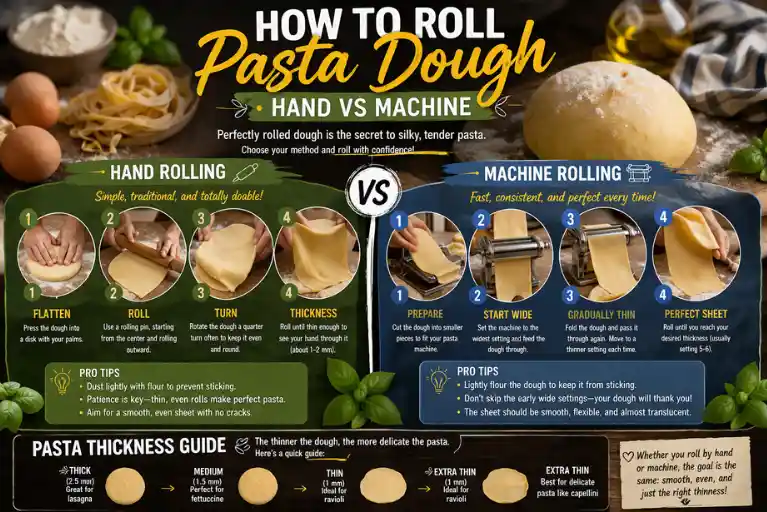
Rolling is where your homemade pasta dough turns into real pasta. You can do it by hand or with a machine.
Rolling Pin Method (By Hand)
- Flatten the dough slightly with your hands
- Use a rolling pin to roll it out evenly
- Rotate the dough often to keep it even
Sensory cue:
- Dough should feel smooth and stretch easily
- No tearing or sticking
Best for beginners learning how to make pasta dough by hand
Pasta Machine Method
- Divide dough into small portions
- Pass it through the widest setting first
- Gradually reduce thickness setting
Pro Tip: Fold and roll again for smoother sheets
Thickness Guide
- Thick sheets → lasagna
- Medium thickness → fettuccine
- Thin sheets → ravioli or delicate pasta
Proper thickness depends on your pasta type
HAND VS MACHINE (COMPARISON TABLE)
| Feature | Hand Rolling | Pasta Machine |
| Effort | High | Low |
| Control | Full control | Consistent results |
| Speed | Slower | Faster |
| Results | Rustic texture | Smooth & even |
| Best For | Beginners & casual cooking | Precision & professional results |
Conclusion:
- Use hand rolling for simplicity
- Use a machine for perfect consistency
BEST FLOUR FOR PASTA DOUGH
Choosing the best flour for pasta dough affects texture and final results.
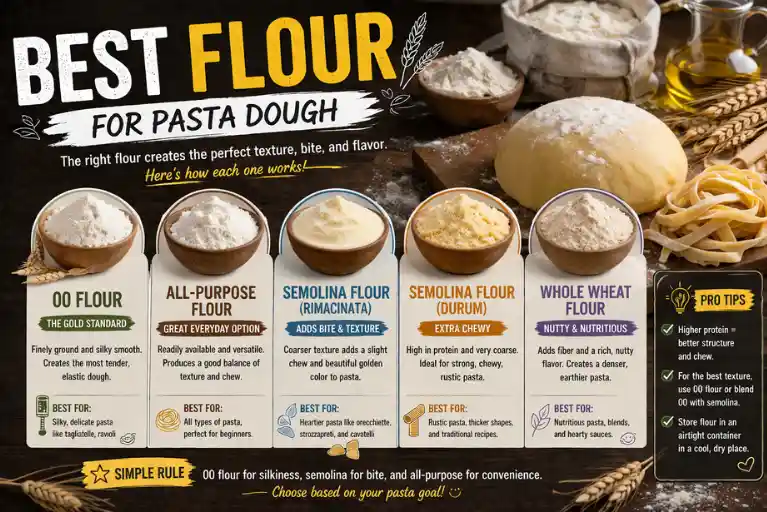
All-Purpose Flour
- Soft texture
- Easy to work with
- Best for beginners
Semolina Flour
- Slightly coarse
- Creates firmer pasta with bite
- Great for spaghetti and dried-style pasta
00 Flour
- Very fine texture
- Makes silky and smooth pasta dough
- Used in traditional Italian pasta
Texture Results & Best Use Cases
| Flour Type | Texture | Best Use |
| All-purpose | Soft & smooth | Beginner pasta |
| Semolina | Firm & chewy | Hearty pasta |
| 00 flour | Silky & delicate | Fine pasta (ravioli, fettuccine) |
Pro Tip: Mixing flours can give the best balance of texture and strength.
DOUGH TEXTURE DIAGNOSTIC GUIDE
This section helps you quickly fix common pasta dough problems.
Dough Too Dry (Signs + Fix)
Signs:
- Cracks on surface
- Hard to knead
- Breaks when stretched
Fix:
- Add a few drops of water or egg
- Knead again until smooth
Dough Too Sticky (Signs + Fix)
Signs:
- Sticks to hands or surface
- Feels wet and soft
Fix:
- Add small amounts of flour
- Knead until it becomes smooth
Dough Too Tough (Signs + Fix)
Signs:
- Hard to roll
- Shrinks back when stretched
Fix:
- Let it rest longer
- Cover and wait 10–15 more minutes
Perfect Dough Indicators
- Smooth surface
- Slightly firm but soft
- Not sticky
- Easy to roll and stretch
When your dough feels like this, your homemade pasta dough is ready for shaping and cooking
COMMON MISTAKES (AND HOW TO FIX THEM)
Even a good homemade pasta dough can go wrong if small details are missed. Here are the most common mistakes and how to fix them.
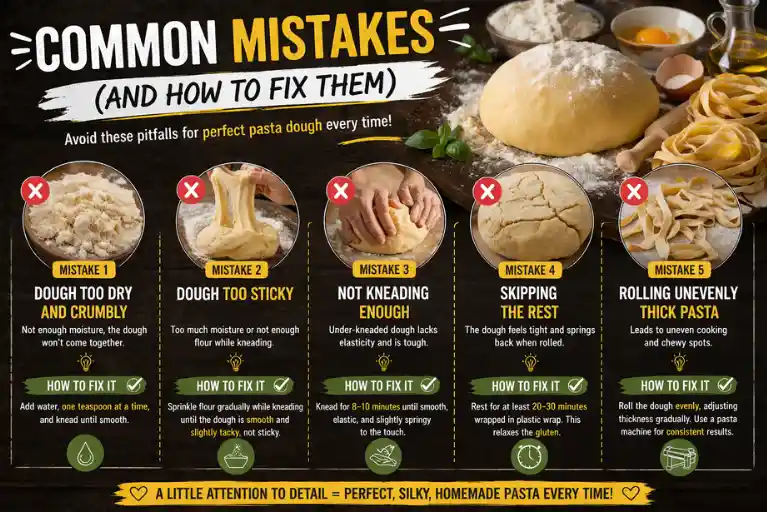
Over-Kneading
- Problem: Dough becomes too tight and hard to roll
- Fix: Let it rest longer to relax the gluten
Balance is key when kneading pasta dough
Under-Resting
- Problem: Dough shrinks back and resists rolling
- Fix: Always rest for at least 20–30 minutes
Wrong Flour Choice
- Problem: Poor texture or weak dough
- Fix: Use the best flour for pasta dough based on your goal
- Beginner → all-purpose
- Firm texture → semolina
Rolling Too Thick or Too Thin
- Problem: Uneven cooking or tearing
- Fix: Follow a proper pasta thickness guide
These small mistakes can affect your final pasta quality a lot
TROUBLESHOOTING GUIDE (ADVANCED FIXES)
This section helps you solve deeper pasta dough problems like a pro.
Dough Cracking
- Cause: Dough too dry
- Fix: Add moisture (water or egg) and knead again
Dough Shrinking
- Cause: Tight gluten (not rested enough)
- Fix: Let it rest longer
Pasta Sticking
- Cause: Too much moisture or not enough flour
- Fix: Dust with flour and keep surfaces dry
Uneven Sheets
- Cause: Uneven rolling or pressure
- Fix: Roll slowly and evenly
Mastering these fixes improves your fresh pasta dough results
CLIMATE & HUMIDITY IMPACT (RARE + POWERFUL)
Most recipes ignore this, but climate affects pasta dough a lot.
Dry Climate Adjustments
- Dough dries out quickly
- Add a little water or egg yolk
- Cover dough while working
Humid Climate Adjustments
- Dough becomes sticky
- Use extra flour while kneading
- Work on a dry surface
Understanding this helps you perfect pasta dough consistency anywhere
PASTA DOUGH VARIATIONS
You can customize your pasta dough recipe based on your needs.
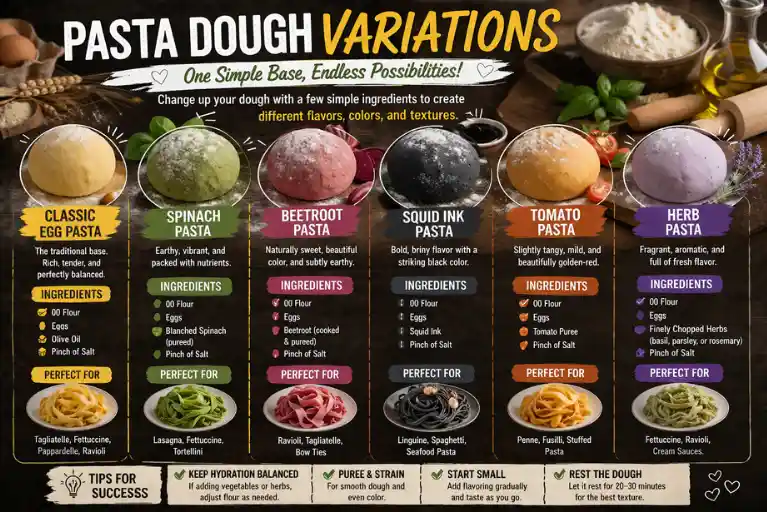
Eggless Pasta Dough
- Flour + water
- Lighter texture
- Good for vegan diets
Whole Wheat Pasta
- Nutty flavor
- Slightly denser texture
- Healthier option
Semolina Pasta
- Firm and chewy
- Great for traditional pasta shapes
BEST USES FOR YOUR DOUGH
Different pasta shapes work better with different dough styles.
Ravioli
- Thin, smooth dough
- Easy to seal
Spaghetti
- Slightly firm dough
- Holds shape well
Lasagna Sheets
- Medium thickness
- Strong structure
Fettuccine
- Smooth and elastic dough
- Easy to cut into ribbons
Choosing the right dough improves your final dish
STORAGE, FREEZING & MAKE-AHEAD GUIDE
Proper storage keeps your homemade pasta dough fresh and usable.
Refrigeration
- Wrap tightly
- Store for up to 24–48 hours
Freezing
- Wrap in plastic or airtight container
- Freeze up to 1–2 months
Shelf Life
- Fresh dough → best used within 1–2 days
- Frozen dough → longer storage
Reusing Dough
- Let it come to room temperature
- Knead lightly before rolling
SHAPING & CUTTING GUIDE
Once your homemade pasta dough is ready, shaping and cutting will turn it into real pasta.
Thickness Levels
- Thick sheets → Best for lasagna
- Medium thickness → Perfect for fettuccine
- Thin sheets → Ideal for ravioli and delicate pasta
Tip: The thinner the dough, the more delicate the pasta
Cutting Techniques
- Use a sharp knife for hand-cut pasta
- Fold the sheet lightly and slice into strips
- Or use a pasta machine cutter for even shapes
Keep the dough lightly floured to prevent sticking
Popular Pasta Shapes
- Spaghetti → Long, thin strands
- Fettuccine → Flat ribbons
- Ravioli → Filled pasta pockets
- Lasagna sheets → Wide, flat layers
Each shape works best with properly rolled fresh pasta dough
FAQs About Homemade Pasta Dough Recipe
Can you make pasta dough without a machine?
Yes, you can easily make pasta dough by hand using a rolling pin. It takes more effort but gives great results.
How long should pasta dough rest?
Let your dough rest for at least 20–30 minutes. This helps relax gluten and improves rolling.
Why is my pasta dough tough?
Your dough may be tough due to over-kneading, not enough rest, or too much flour. Let it rest longer to fix it.
Can you freeze pasta dough?
Yes, you can freeze homemade pasta dough for up to 1–2 months. Wrap it tightly before storing.
PRO CHEF TIPS (FINAL EDGE)
These simple tips can take your pasta dough recipe to the next level.
Secrets for Silky Pasta
- Use 00 flour for smooth texture
- Knead until the dough is perfectly smooth
- Always let the dough rest properly
Restaurant-Level Tips
- Roll dough gradually for even thickness
- Dust lightly with flour to avoid sticking
- Work in small portions for better control
Final Do’s & Don’ts
Do:
- Use the correct pasta dough ratio
- Test dough texture before rolling
- Keep your surface clean and floured
Don’t:
- Skip resting time
- Add too much flour at once
- Rush the kneading process
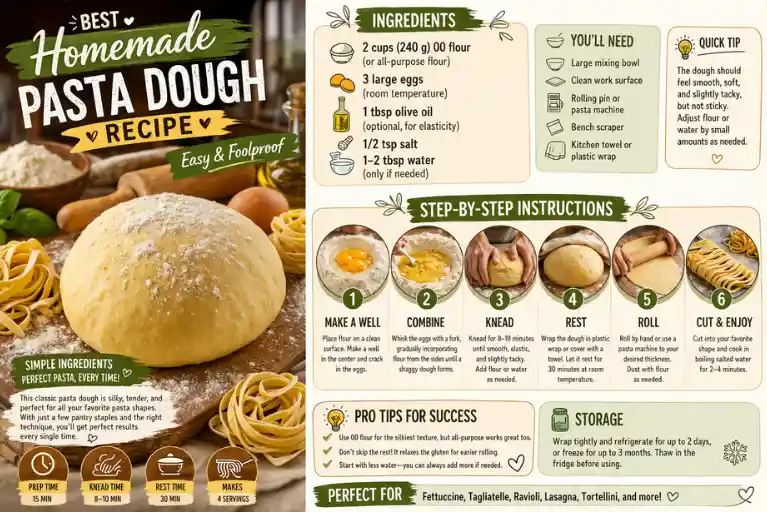
RECIPE CARD – Best Homemade Pasta Dough Recipe (Easy & Foolproof)
Course: Main Dishes, PastaCuisine: ItalianDifficulty: Easy3
servings15
minutes30
minutes300
kcalThis homemade pasta dough recipe is simple, reliable, and perfect for beginners. Made with just flour and eggs, it creates smooth, elastic dough that rolls easily into fresh pasta like spaghetti, fettuccine, or ravioli. Follow this step-by-step pasta dough guide to get perfect texture every time.
Ingredients
1 cup all-purpose flour (or 00 flour)
1 large egg
Pinch of salt (optional)
Few drops of water or olive oil (if needed)
Instructions
- Place flour on a clean surface and create a well in the center
- Crack the egg into the middle and start mixing with a fork
- Combine until a rough dough forms
- Knead for 8–10 minutes until smooth and elastic
- Wrap and let the dough rest for 20–30 minutes
- Roll out using a rolling pin or pasta machine
- Cut into your desired pasta shape
Recipe Video
Notes
- Use the correct pasta dough ratio (1 cup flour : 1 egg)
- Dough should feel smooth, firm, and slightly elastic
- If dough is too dry → add a little water
- If too sticky → add a small amount of flour
FINAL THOUGHT
Making homemade pasta dough is not just about following a recipe—it’s about understanding the texture, technique, and timing. Once you learn how the dough should feel and how to adjust it, the process becomes simple and enjoyable.
With the right pasta dough consistency, proper kneading, and a little practice, you can create fresh, delicious pasta anytime at home. Start simple, follow the steps, and soon you’ll be making pasta like a pro