
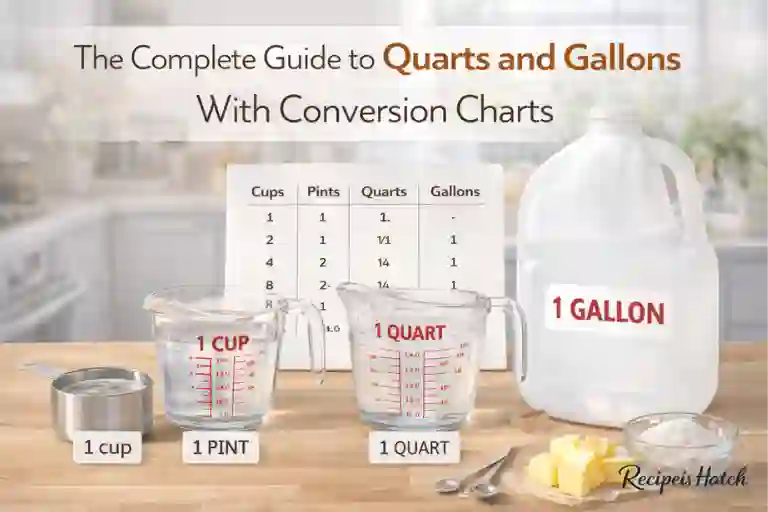
If you’ve ever wondered how many quarts are in a gallon, you’re not alone. Whether you’re cooking, measuring liquids for recipes, or just curious about volume conversions, knowing this simple fact can save time and prevent mistakes. The quick answer is straightforward: 1 gallon equals 4 quarts. But understanding this relationship is just the beginning.
In this complete guide, we’ll break down everything you need to know about quarts and gallons, including conversion formulas, tables, and real-life examples. You’ll also learn the difference between US liquid and dry gallons, Imperial gallons, and how to convert these measurements to metric units like liters. By the end of this guide, converting quarts to gallons and vice versa will feel effortless, whether you’re in the kitchen, at school, or handling everyday measurements.
What Are Gallons and Quarts?
Understanding gallons and quarts is the first step in mastering volume conversions.
Definition of a Quart
A quart is a unit of volume measurement used to measure liquids and sometimes dry ingredients. In the US system, 1 quart equals 4 cups or 2 pints. Quarts are commonly used in cooking, baking, and grocery measurements, making them an essential unit to understand for everyday conversions.
Definition of a Gallon
A gallon is a larger unit of liquid or dry volume. In the US system, 1 gallon equals 4 quarts or 16 cups. Gallons are widely used to measure liquids like milk, water, and juice, as well as for gasoline and other fluids.
US vs Imperial vs Dry Gallons/Quarts
Not all gallons and quarts are the same. The US liquid gallon differs slightly from the Imperial gallon (UK), which is larger. Additionally, the US dry gallon is used for measuring dry goods, like grains, and is slightly different in size from the liquid gallon.
Why Volume Units Differ Between Systems
Volume units differ because countries developed their own measurement standards over time. The Imperial system was designed in the UK, while the US customary system evolved from it but kept slightly different gallon and quart sizes. Understanding these differences is key when converting quarts to gallons or using metric equivalents.

You might also like: The Best Potato and Hamburger Soup Recipe Ever Tried
Understanding Volume Units
When learning how many quarts are in a gallon, it’s helpful to understand the related volume units used in everyday measurements. Common units include pints, cups, and fluid ounces, which all connect directly to quarts and gallons.
Overview of Related Units
- 1 pint = 2 cups
- 1 quart = 2 pints = 4 cups
- 1 gallon = 4 quarts = 8 pints = 16 cups
- 1 cup = 8 fluid ounces
These relationships make it easy to convert between units in the kitchen, for recipes, or in other daily measurement tasks.
Visual Diagram: The Volume Ladder
Imagine a simple volume ladder to see how units stack:
Ounces → Cups → Pints → Quarts → Gallons
Each step shows how smaller units combine to form larger ones, making quarts to gallons conversions quick and easy to visualize.
How Units Relate for Conversions
By understanding these unit relationships, you can easily calculate how many quarts are in a gallon, how many cups are in a quart, or even convert gallons to pints. This is especially helpful for recipes, cooking measurements, and daily liquid conversions.
Core Conversions
Now that we understand the volume units, let’s look at the core conversions between quarts and gallons and related measurements. These formulas make it easy to convert quarts to gallons and gallons to quarts for cooking, recipes, or everyday measurements.
A. Quarts to Gallons
To convert quarts to gallons, use this simple formula:
Gallons = Quarts ÷ 4
Examples:
- 8 quarts ÷ 4 = 2 gallons
- 20 quarts ÷ 4 = 5 gallons
This formula works for both US liquid gallons and dry gallons, but remember to check which system you are using.
B. Gallons to Quarts
To convert gallons to quarts, the formula is even simpler:
Quarts = Gallons × 4
Examples:
- 3 gallons × 4 = 12 quarts
- 7 gallons × 4 = 28 quarts
Using this formula, you can quickly calculate how many quarts are in a gallon for any number of gallons.
C. Other Useful Conversions
Sometimes, you may need to work with cups, pints, fluid ounces, or metric equivalents. Here’s a quick reference:
- 1 gallon = 4 quarts = 8 pints = 16 cups = 128 fluid ounces
- 1 quart = 2 pints = 4 cups = 32 fluid ounces
- Metric equivalents: 1 US gallon ≈ 3.785 liters, 1 quart ≈ 0.946 liters
With these conversions, you can handle any volume measurement in the kitchen, for recipes, or daily use, whether using US customary units or metric units.
Conversion Tables
Having conversion formulas is helpful, but seeing the numbers in tables makes it even easier to understand how many quarts are in a gallon and related units. Below are practical, easy-to-read tables for your daily use.
A. US Standard Table: Gallons ↔ Quarts
| Gallons | Quarts |
| 1 | 4 |
| 2 | 8 |
| 3 | 12 |
| 5 | 20 |
| 10 | 40 |
This table shows the direct relationship between gallons and quarts, perfect for quick reference in the kitchen or for liquid measurements.
B. Extended Table: Gallons, Quarts, Pints, Cups, Fluid Ounces
| Gallons | Quarts | Pints | Cups | Fluid Ounces |
| 1 | 4 | 8 | 16 | 128 |
| 2 | 8 | 16 | 32 | 256 |
| 5 | 20 | 40 | 80 | 640 |
| 10 | 40 | 80 | 160 | 1280 |
This extended table is useful when converting gallons to pints, cups, or ounces, making it easier to handle cooking recipes or daily liquid tasks.
C. Metric Table: Gallons/Quarts → Liters
| Unit | Liters |
| 1 US gallon | 3.785 L |
| 1 US quart | 0.946 L |
| 2 gallons | 7.57 L |
| 4 quarts | 3.785 L |
Including metric equivalents ensures your conversions work in international recipes or scientific measurements.
D. Printable Chart Suggestion
For convenience, you can create a PDF version of these tables to keep in your kitchen, classroom, or workspace. A printable chart makes it quick to check quarts to gallons, gallons to quarts, and related units without using a calculator.
Measurement System Comparisons
When converting quarts to gallons or vice versa, it’s important to understand that not all gallons and quarts are the same. Different systems use slightly different measurements, which can affect recipes, scientific calculations, and industrial tasks.
A. US Liquid vs Dry Gallon/Quart
In the US customary system, there are liquid and dry measurements:
- US liquid gallon: Commonly used for milk, water, juice, and other liquids. 1 gallon = 4 quarts.
- US dry gallon: Used for dry goods like grains or produce. Slightly larger than the liquid gallon.
- 1 US dry quart = 1/4 dry gallon.
Knowing which one to use ensures accurate conversions for cooking, baking, and storage.
B. Imperial (UK) Gallon vs US Gallon
The Imperial gallon, used in the UK, is larger than the US gallon.
- 1 Imperial gallon = 4.546 liters (vs 3.785 liters for US gallon).
- 1 Imperial quart = 1/4 Imperial gallon = 1.136 liters.
When following UK recipes or measurements, it’s essential to use the correct system to avoid errors in volume conversions.
C. Metric Equivalents
For international or scientific use, it helps to convert gallons and quarts to liters:
- 1 US gallon ≈ 3.785 liters
- 1 US quart ≈ 0.946 liters
- 1 Imperial gallon ≈ 4.546 liters
- 1 Imperial quart ≈ 1.136 liters
These equivalents make it easy to switch between systems without guessing.
D. Tips for Using the Correct System
- Always check if the recipe or formula specifies US or Imperial units.
- Use dry gallons/quarts only for solid or dry ingredients.
- For scientific or industrial measurements, convert to metric units for precision.
- Label containers clearly to avoid confusion between US liquid, US dry, and Imperial measurements.
Practical Real-World Examples
Understanding how many quarts are in a gallon is more than just theory—it’s practical for everyday life. Let’s explore some real-world examples where knowing these conversions is helpful.
A. Cooking & Recipes
Whether you’re making soup, sauces, or baking, knowing that 1 gallon = 4 quarts helps you measure liquids like milk, water, or oil accurately. For example, if a recipe calls for 2 gallons of water, you now know that’s 8 quarts, which is easier to pour using standard kitchen containers.
B. Grocery Shopping & Beverage Purchases
When buying drinks, juices, or milk, understanding gallons, quarts, and pints makes it easier to compare sizes and prices. For instance, buying 1 gallon of juice is the same as 4 quarts, so you can check which packaging gives the best value.
C. Classroom & Science Experiments
Teachers and students often need precise liquid measurements for experiments. Knowing how many quarts are in a gallon helps convert measurements for solutions, beakers, and lab experiments, ensuring accuracy without mistakes.
D. Automotive & DIY Fluid Measurements
Fluids like engine oil, coolant, or windshield washer fluid are often measured in quarts and gallons. Understanding these conversions ensures you use the correct amounts, whether filling your car or working on a DIY project.
Why Quarts & Gallons Are Structured This Way
Understanding why a quart equals a quarter of a gallon helps make volume conversions easier to remember.
A. Historical Context of Quarts and Gallons
The gallon and quart have been used for centuries. Originally, these units came from medieval Europe, where merchants needed standard volume measurements for wine, ale, and grains. Over time, the US adopted its own system, while the UK continued using the Imperial system. This history explains why the US liquid and dry gallons differ slightly from Imperial gallons today.
B. Why a Quart Equals a Quarter of a Gallon
The word “quart” comes from the Latin quartus, meaning “one-fourth”. By definition, 1 quart = 1/4 gallon, which made it easy for traders, cooks, and everyday users to measure liquids without complicated calculations.
C. Interesting Facts & Fun Trivia
- The US dry gallon is used less today but was important for measuring grains and produce.
- Some early recipes in history still reference quarts and pints rather than modern metric units.
- Fun tip: A gallon of water weighs about 8.34 pounds, which is handy for estimating weight while cooking or carrying liquids.
Common Mistakes & Tips
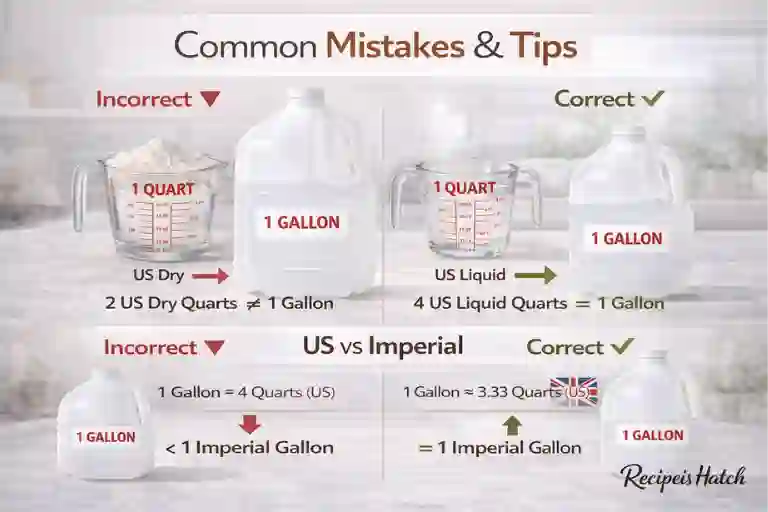
Even when you know how many quarts are in a gallon, it’s easy to make mistakes. Understanding these common errors can help you convert quarts to gallons accurately every time.
A. Confusing Dry vs Liquid Measurements
One of the most frequent mistakes is mixing up US liquid and dry gallons/quarts. Dry gallons are slightly larger than liquid gallons, so using the wrong one can affect recipes or measurements for grains, produce, or liquids. Always check which type is required
B. Misreading Imperial vs US Measurements
Another common error is assuming Imperial gallons are the same as US gallons. Remember: 1 Imperial gallon ≈ 4.546 liters, while 1 US gallon ≈ 3.785 liters. Using the wrong system can lead to over- or under-measuring liquids in recipes or projects.
C. Miscalculating Conversions in Recipes
Even simple recipes can go wrong if you miscalculate quarts to gallons or gallons to quarts. Always use the formula:
- Gallons = Quarts ÷ 4
- Quarts = Gallons × 4
Double-check your math to avoid errors in cooking or other measurements.
D. Quick Hacks to Remember Conversions
- Think “quart = quarter” to remember 1 quart = 1/4 gallon.
- Visualize a volume ladder: ounces → cups → pints → quarts → gallons.
- Keep a small conversion chart in your kitchen or workspace for quick reference.
Interactive Tools & Visual Aids
To make converting quarts to gallons even easier, using interactive tools and visual aids can save time and reduce mistakes. These resources are especially helpful for cooking, science experiments, and everyday measurements.
A. Embedded Conversion Calculator (Optional)
Many websites offer online calculators that instantly convert quarts to gallons, gallons to quarts, or related units like pints and cups. These tools are perfect for quick checks, especially when following recipes or doing classroom experiments.
B. Visual Unit Comparison Diagram
A volume ladder diagram shows how fluid ounces, cups, pints, quarts, and gallons relate to each other. This visual aid makes it easy to understand how many quarts are in a gallon at a glance.
C. Printable Tables and Cheat Sheets
Keeping a printed conversion table in your kitchen, classroom, or workspace helps with fast reference. Cheat sheets should include:
- Gallons ↔ Quarts
- Quarts ↔ Pints/Cups/Fluid ounces
- Metric equivalents (liters)
D. Suggested Smartphone Apps for Conversions
There are mobile apps available that allow you to quickly convert gallons, quarts, pints, cups, and ounces. They are handy when shopping, cooking, or measuring fluids on the go.
FAQs (Frequently Asked Questions)
1. How many quarts are in a gallon of milk, water, or oil?
1 gallon = 4 quarts, whether it’s milk, water, or oil. This is true for US liquid gallons, which are the most commonly used in recipes and daily measurements. Always check if your recipe or source specifies US or Imperial gallons, as the numbers differ slightly.
2. How many pints are in a quart or gallon?
- 1 quart = 2 pints
- 1 gallon = 4 quarts = 8 pints
Knowing this helps you convert quarts to gallons or pints quickly for cooking, grocery shopping, and fluid measurements.
3. Is a quart the same as a liter?
No. 1 US quart ≈ 0.946 liters, and 1 Imperial quart ≈ 1.136 liters. Understanding this is important for metric conversions, especially in international recipes or scientific measurements.
4. How to convert quarts to liters quickly?
Use this simple formula:
Liters = Quarts × 0.946 (for US quarts)
For Imperial quarts, multiply by 1.136. Using this method, you can convert quarts to liters quickly without guessing.
5. What is the difference between dry and liquid gallons?
- US liquid gallon: Used for liquids, standard for recipes and beverages.
- US dry gallon: Slightly larger, used for dry ingredients like grains and produce.
Using the wrong type can lead to measurement errors, so always check your recipe or source.
6. How do US and Imperial gallons differ?
- 1 US gallon ≈ 3.785 liters
- 1 Imperial gallon ≈ 4.546 liters
- 1 US quart ≈ 0.946 liters, 1 Imperial quart ≈ 1.136 liters
This difference matters when using UK recipes, international measurements, or science experiments, so double-check the system you’re using.
Summary & Takeaways
Let’s quickly recap the key points from this guide so you can convert quarts to gallons and vice versa with confidence:
- 1 gallon = 4 quarts, and 1 quart = 2 pints = 4 cups = 32 fluid ounces.
- US liquid and dry gallons differ slightly, and Imperial gallons are larger than US gallons.
- Metric equivalents: 1 US gallon ≈ 3.785 liters, 1 US quart ≈ 0.946 liters.
- Remember the simple trick: “quart = quarter” of a gallon to make conversions easy.
We hope this guide helps you with cooking, recipes, grocery shopping, science experiments, and everyday measurements.